
Does Your Product Really Need AI?
A practical guide for founders and product managers to decide when AI actually adds value. Learn how to evaluate data readiness, real user impact, and differentiation—so you build with intent, not hype.”
Mayur Hatwar
4/14/20263 min read
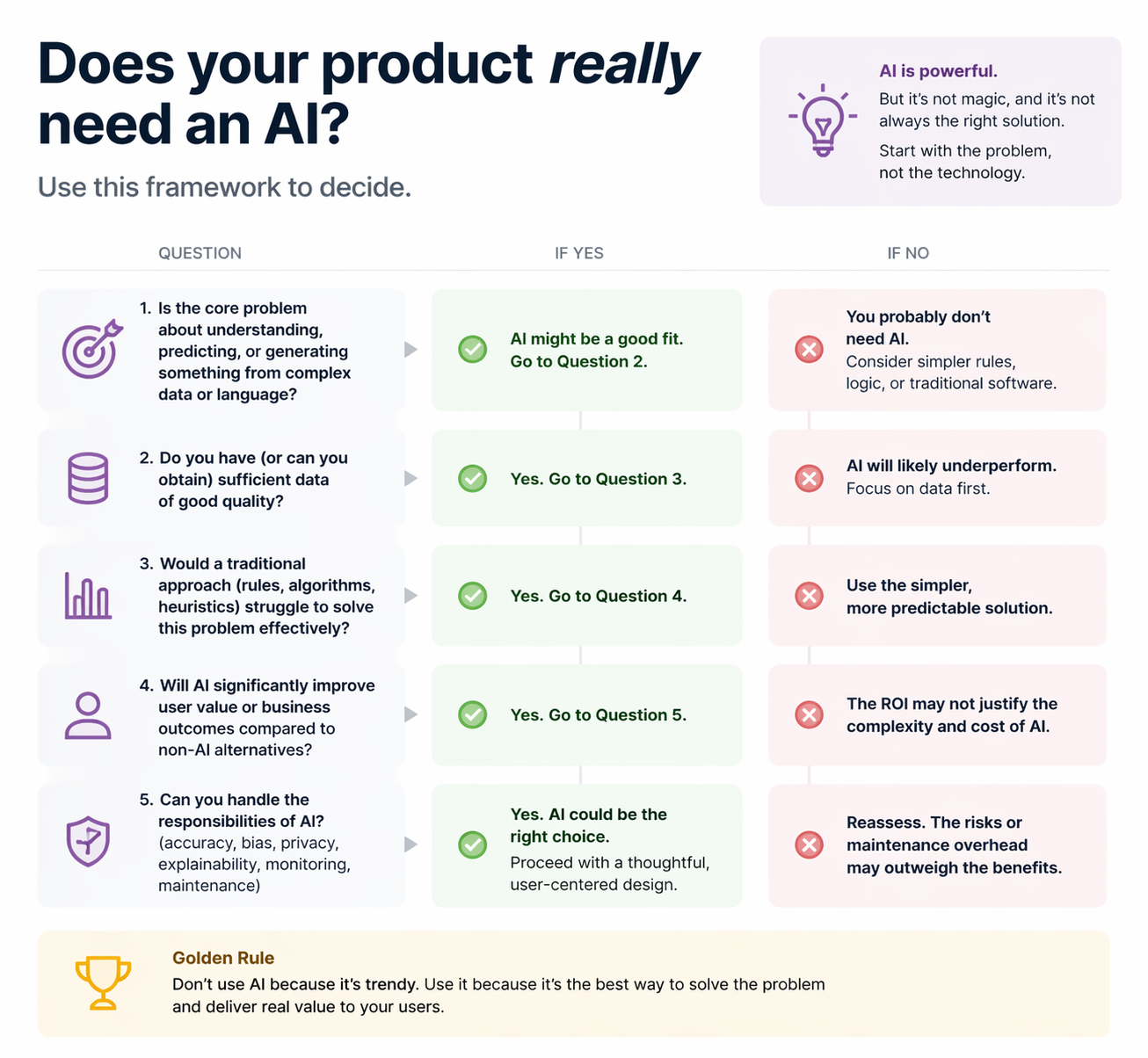
Does Your Product Really Need AI?
If you’re building a product today, you’ve probably felt this growing tension:
Investors keep asking, “What’s your AI angle?”
Competitors announce new “AI-powered” features each month.
Your team is excited about AI, but you’re not entirely sure where it actually fits.
The result? Pressure to “add AI”—without clear answers on why or where it truly belongs. This article is for founders and product leaders who want to stay ambitious about AI while being grounded about ROI.
The Real Problem: AI as a Checkbox
AI has become the new checkbox — a buzzword sprinkled across decks and landing pages. You’ve probably seen it:
“AI assistant” features where users never asked for one
Roadmaps crowded with AI projects while core UX issues remain unresolved
Launch demos that shine, but fall short in real-world usage
Underneath all the hype, one truth remains:
Users don’t care if it’s AI. They care if it helps them win.
Often, a simple rule-based system or improved workflow outperforms a complex model.
So instead of asking, “Where can we add AI?”, try asking, “Where is our current approach clearly not good enough?”
Let’s unpack that through three practical questions.
Question 1: Do You Have Enough Good Data?
AI runs on data the way an engine runs on fuel — without enough of the right kind, even the best model sputters.
When AI usually makes sense:
You have large, consistent datasets across users or transactions.
You can label outcomes clearly — converted vs didn’t, fraud vs legit, retained vs churned.
You have the legal and ethical rights to use that data.
Example:
A B2B analytics product with years of transaction logs and clear fraud labels can apply anomaly detection or forecasting models to uncover hidden patterns humans miss.
When AI is premature:
Your product has just launched and data is sparse or noisy.
You don’t track the outcomes you hope to optimize.
Crucial context lives in people’s heads or unstructured notes.
In these cases, it’s smarter to:
Improve event tracking and data structure.
Clarify metrics that define success.
Revisit AI once you have a reliable signal to learn from.
Without that groundwork, “AI personalization” and “AI predictions” end up as guesswork dressed in hype.
Question 2: Does AI Clearly Beat a Simpler Approach?
Next comes value.
If you compare an AI-driven solution to a simpler one, does AI clearly win for your user?
Pattern 1 – Overkill with AI:
A healthcare startup wants to “automate consultations with an AI chatbot.”
Potential issues emerge — patients may distrust automated diagnosis, doctors face liability risks, and results vary widely.
A better option:
Structured symptom forms, rule-based triage, and quick routing to human experts.
No fancy AI, just a grounded system that respects trust and compliance.
Pattern 2 – AI where it truly helps:
Writing assistants or coding copilots are excellent examples.
They catch mistakes, save time, and make workflows lighter. Turn them off, and users instantly notice the downgrade.
That’s real value.
For your product, ask:
If we removed the AI tomorrow, would users feel a noticeable loss in quality, speed, or confidence?
Or would they barely notice?
If it’s the latter, AI might not be solving your core problem.
Question 3: Will This Actually Differentiate You?
AI is powerful — but also easy to copy.
Open models, APIs, and public tools make “basic AI features” accessible to everyone.
So:
“Our AI chatbot” is no longer unique.
“We summarize text with AI” is commonplace.
“We added an AI assistant” sounds just like everyone else.
True defensibility comes from:
Proprietary data your competitors can’t access.
Deep understanding of niche workflows and language.
Integrations and UX tailored to your product’s context.
Example:
Product A uses a public model to answer FAQs.
Product B trains on years of domain-specific data, usage logs, and support tickets — creating tailored experiences.
Both say “AI support,” but only one builds lasting advantage.
When defining your AI roadmap, ask:
What’s genuinely ours — unique data, insights, or workflows?
How quickly could someone replicate this?
Are we building a long-term asset or a short-term demo?
The Founder & PM AI Readiness Checklist
Before you lock in AI investments, run this quick sanity check:
Data: Do we have enough clean, relevant, and legally usable data?
Value: Would users feel a downgrade without the AI?
Differentiation: Does it leverage something uniquely ours?
Cost: Are we prepared for ongoing expenses — infrastructure, tuning, monitoring, updates?
Simpler options: Is there a non-AI solution that achieves 70–80% of the value faster?
Final Thoughts
Don’t build AI features to chase trends — build them because they make your product unmistakably better.
The best AI is invisible.
It doesn’t shout “AI” — it simply makes your product smarter, smoother, and more valuable